PDF Exam Prep vs Interactive Testing Platforms: Which Wins?
Compare PDF exam prep vs interactive testing platforms to find the best study method for your next exam. Discover pros, cons, and value for money.
PDF exam prep vs interactive testing comes down to how you learn and what your exam demands. PDFs are better for low-cost, offline reading, annotation, and review at your own pace. Interactive Testing Platforms are usually better for candidates who need timed exam practice, automatic scoring, explanations, and a clear view of weak areas, while learning about legitimate IT certification practice can help you choose reliable materials. For a high-stakes, computer-based certification, interactive practice is often the stronger primary tool; a PDF can still be a useful supplement when you’re choosing professional certification study guides.
How the two study methods work
PDF exam prep and interactive testing support different study workflows. A PDF gives you a fixed document to read and work through; an interactive platform turns questions into an assessed practice session, often with feedback and performance tracking.
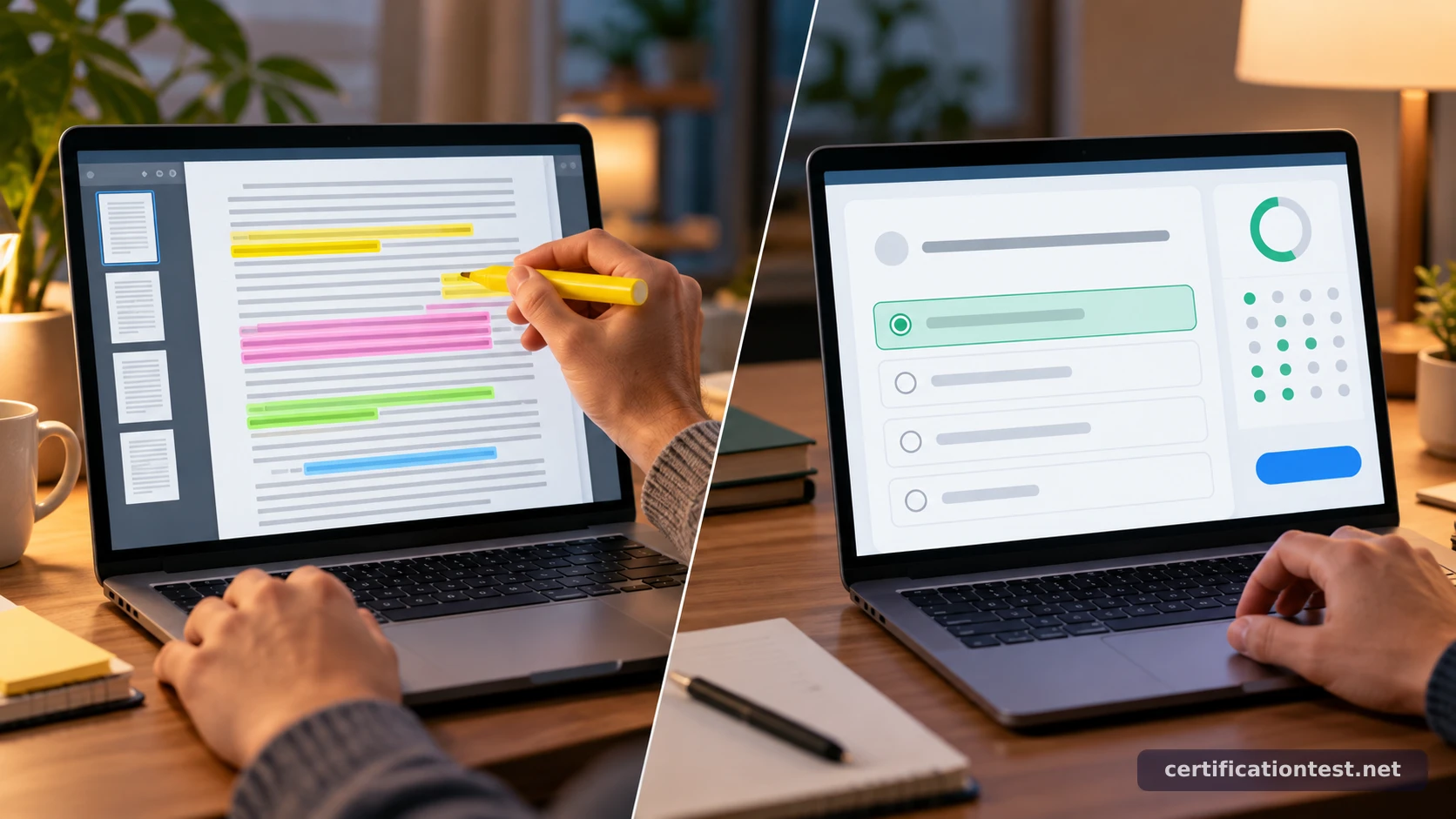 PDF Exam Prep vs Interactive Testing Platforms: Which Wins? - How the two study methods work
A static document versus a responsive assessment
PDF materials commonly include study guides, question banks, answer keys, and scanned past papers. You can download or print them, annotate passages, and study without an internet connection. But the document does not respond to your answers: you must record responses, find the key, calculate your score, and locate explanations yourself.
An interactive platform presents questions in software or a browser. Depending on the product, it may support timed mock exams, instant scoring, detailed rationales, and question formats beyond multiple choice, such as drag-and-drop, hotspots, or case studies. Some platforms track missed topics and use them to build focused remediation quizzes.
That distinction matters for certification candidates. Reading about a cloud service is not the same as recalling its configuration under time pressure. Likewise, a platform cannot replace careful study of unfamiliar concepts simply by showing a score. Learning still depends on reviewing explanations and returning to the relevant material.
A typical study session
With a PDF, the workflow is manual: read or answer a block of questions, note responses, check the answer key, and investigate mistakes. This is straightforward but takes discipline, especially when you want to compare results across several sessions.
In interactive testing, you choose a mode, answer in the interface, submit, and review results. Study mode can provide feedback as you go; exam mode can help you practice pacing before test day. The closest fit depends on the platform and the certification exam, so check that its question types and test experience match your needs.
Head-to-head comparison: what matters for exam preparation
Neither format wins every category. PDFs prioritize portability and control, while interactive testing prioritizes feedback, simulation, and measurable progress.
| Comparison criterion in English | PDF exam prep vs interactive testing | Interactive Testing Platforms | Verdict in English |
|---|---|---|---|
| Core format | Static guides, questions, and answer keys | Software-based assessments with dynamic questions | Choose based on whether reading or active test practice is your main need |
| Offline access | Downloaded files can be used offline with a PDF reader | Cloud platforms generally depend on internet access; device compatibility may vary | PDF for unreliable connectivity |
| Feedback | Usually requires manual answer checking and explanation lookup | Can provide automated scoring and immediate explanations | Interactive platforms for faster review |
| Progress tracking | No built-in history or trend dashboard | May track scores, time per question, and weak areas | Interactive platforms for measurable progress |
| Exam simulation | Does not reproduce a computer-based testing interface | Can offer timed mock exams and interactive question types | Interactive platforms for CBT preparation |
| Learning flexibility | Fixed sequence; learner chooses what to revisit | Some platforms adapt practice to performance | Interactive platforms when targeted remediation is available |
| Accessibility and handling | Easy to print, highlight, and annotate | Features vary; some include accessibility options | Depends on personal preferences and product design |
| Cost and pricing model | Often free or low-cost; file ownership may be permanent | May require a subscription or one-time license | Compare the specific product, not just the format |
| Certificationtest pricing | Exam-based digital products; exact cost is shown after selecting a certification track | An online test engine is available as an add-on; no public price or quota is specified here | Check the selected exam module for current pricing |
| Data and quotas | No platform usage quota for a saved local file, though document size and device storage still matter | Pricing may depend on seats, test-taker volume, or assessment volume; terms vary by provider | Confirm limits and renewal terms before buying |
What the comparison means in practice
For a learner who needs to understand a complex topic, a PDF can be a comfortable place to annotate definitions, compare concepts, and make personal notes. For a candidate who already knows the material but struggles with pacing or question interpretation, timed interactive practice can expose those problems more directly.
The platform category includes products built for different audiences. A tool designed for corporate hiring may emphasize live coding, candidate screening, or proctoring rather than certification preparation. Look for certification-aligned content, credible explanations, and a test mode that resembles your actual exam—not merely a long list of software features.
Pricing also needs context. Interactive platforms may charge by subscription, license, seats, or assessment volume, while PDF resources may be sold once or offered freely. These models are not directly comparable without knowing the included content, access period, renewal terms, and whether explanations or mock exams are included. Certificationtest offers exam-based pricing; the specific cost is provided when you select a certification track. No fixed price or usage quota is stated here, so check the product details before purchase.
Pros, cons, and value for money
The best-value choice is the one that solves your actual study problem without paying for features you will not use. A low-cost PDF can be sufficient for reference, but savings matter less if you need realistic practice and spend time manually grading every session.
PDF exam prep: strengths and limitations
Pros
- Works offline after download and is easy to carry between devices.
- Supports printing, highlighting, and handwritten notes.
- Often costs little or nothing, with no recurring subscription for a saved file.
- Requires no specialized testing software beyond a standard PDF reader.
Cons
- Does not automatically score answers or explain performance patterns.
- Requires manual tracking, grading, and follow-up on missed questions.
- Cannot adapt question selection to areas where you are struggling.
- Provides little or no practice with a computer-based exam interface.
PDFs can offer strong value when your priority is reading, reference, or offline access. Their limitations become more consequential when you need repeated timed practice or want to know whether your errors cluster around a particular objective. A document’s low purchase price does not guarantee its questions are accurate, current, or relevant, so evaluate the source and the material’s alignment with your exam objectives.
Interactive Testing Platforms: strengths and limitations
Pros
- Automated grading can reduce the effort between answering and reviewing.
- Timed simulations help you practice pacing and screen-based test habits.
- Explanations and analytics can make mistakes easier to investigate.
- Some platforms use performance data to focus later practice on weaker areas.
Cons
- Cloud tools may require reliable internet access.
- Subscription or license costs can exceed the cost of a single static file.
- Device compatibility and available question types vary by platform.
- Advanced capabilities—such as proctoring, coding sandboxes, or adaptive tests—are not guaranteed in every product.
A feature list is not proof of exam readiness. Confirm that the platform provides practice relevant to your certification and that its explanations help you understand why an answer is correct. Certificationtest combines expert-verified exam preparation materials with an online test engine offered as an add-on; pricing is set per exam module, with the cost shown when you select a track. That model may suit candidates who want exam-focused resources, but compare the exact materials and access terms with alternatives.
Which option should you choose?
Choose according to your biggest preparation gap: missing knowledge, weak recall, poor pacing, or limited access to a reliable device and connection. Many candidates can use a PDF for reference and interactive practice for assessment rather than treating the formats as mutually exclusive.
A practical buyer decision framework
Choose PDF exam prep when:
- You need offline materials because your internet access is limited or intermittent.
- You learn effectively by reading, printing, highlighting, or annotating.
- You want a reference guide or question set to revisit without logging in.
- The subject is niche and the most useful available source is a scanned text or syllabus document.
- You are prepared to track answers and scores manually.
Choose an interactive platform when:
- Your certification exam is computer-based and you need to practice on-screen.
- You need timed mock exams to improve pacing and concentration.
- You want automated scoring, explanations, or analytics on missed questions.
- You benefit from targeted practice on weak topics.
- The platform’s question content and interface are relevant to your specific exam.
If you are uncertain, start with a short diagnostic set or a sample session where one is available. Record not only your score, but also why you missed questions: lack of knowledge, misreading, guessing, or running out of time. A low score caused by unfamiliar concepts calls for study and explanation review; repeated time-pressure errors call for timed practice.
For an exam-specific option, browse expert-verified IT certification practice tests and PDF exam prep and check the selected track’s content and pricing. Treat any practice product as preparation, not a guarantee of passing: verify exam objectives and use explanations to build understanding rather than memorizing answer patterns.
A balanced study routine
A practical combined routine can use each format for what it does well:
- Study a topic in a guide or PDF, making notes on concepts you cannot explain clearly.
- Attempt questions without looking at the answer key or explanation.
- Use interactive practice for timed sessions and immediate scoring when available.
- Review every miss, identify the underlying knowledge gap, and return to the relevant topic.
- Repeat a focused set later to check whether you can recall and apply the concept—not just recognize a memorized answer.
This approach avoids two common mistakes: reading passively without testing recall and taking repeated mock exams without learning from errors. Your study plan should also reflect the exam format. If the actual test uses multiple question types or a strict time limit, choose practice that prepares you for those conditions.
FAQ
Is PDF exam prep or interactive testing better for certification exams?
For a computer-based certification with timed questions, interactive testing is often the better tool for practicing exam conditions and reviewing performance. A PDF remains useful for offline reading, annotation, and reference. The strongest choice depends on your weak points, the quality of the exam-aligned content, and whether the platform’s question formats reflect the test you will take.
Are Interactive Testing Platforms worth paying for?
They can be worth the cost if automated scoring, timed simulations, explanations, or performance analytics save you time and improve the quality of your practice. Compare the actual content, access period, device requirements, and any usage limits before paying. Some platforms use subscriptions or licenses, but pricing and included features vary; do not assume every platform offers adaptive testing or the same tools.
Can I prepare using only PDF exam prep?
You can prepare with PDFs if they provide suitable material and you can consistently check answers, investigate mistakes, and track progress. The main drawback is that scoring and review are manual, and PDFs do not simulate a computer-based testing interface. If pacing or on-screen exam familiarity is important, add timed practice through an appropriate interactive testing tool.